Environmental monitoring
Prediction of contamination by analyzing seasonal and operational trends, mitigating risk before microbiological plating.

Quality 4.0 & Compliance ANVISA
We transform reactive operations into regulatory intelligence centers. We implement AI models for data integrity, deviation management and continuous compliance with ANVISA, PIC/S and GMP.

Quality Assurance based on manual log review and late detection of deviations does not keep up with the speed of global pharmaceutical chains nor the maturity required by modern inspections. The regulatory paradigm migrates from containment to anticipation.
Harmonization PIC/S and RDC 658/2022 require continuous monitoring, not just retrospective.
Sensors, MES and LIMS generate data beyond human ability to analyze — risk of Data Rich, Information Poor.
Increasingly shorter deviation investigation cycles under increasing audit scrutiny.
Quality 4.0 stops being a differentiator and becomes a regulated competitive prerequisite.
Prediction of contamination by analyzing seasonal and operational trends, mitigating risk before microbiological plating.
Identification of subtle patterns in processes that precede OOS and OOT, before the batch is committed.
Automated checking of Batch Records, protocols and technical logs against inconsistencies and ALCOA+ violations.
Automatic clustering of occurrences and systemic root cause suggestion for effective corrective actions.
Integration with HVAC, WFI and cleanrooms for real-time failure prediction and regulatory impact.
Advanced statistical models for Periodic Product Review and integrated quality risk management (ICH Q9).
Regulatory competitive advantage is not just compliance, but the ability to anticipate risks before they materialize into deviations, non-conformities or inspection observations.
Manual analyses, data silos, and weeks-long deviation investigations.
Continuous real-time monitoring with predictive alerts based on validated machine learning.
| Dimension | Traditional | With AI |
|---|---|---|
| Deviation management | Post-occurrence investigation | Real-time pattern detection |
| Data integrity | Sampling verification | 100% automated audit (ALCOA+) |
| Monitoring | Periodic Snapshots | Continuous Process Verification (CPV) |
| Compliance | Reactive to audits | Audit-readiness permanente |
| CAPA | Specific corrective actions | Systemic root cause elimination |
ANVISA adopts international regulatory convergence (PIC/S and ICH) for 2026, focusing on Annex 22: AI in critical environments must be controllable, testable and predictable.
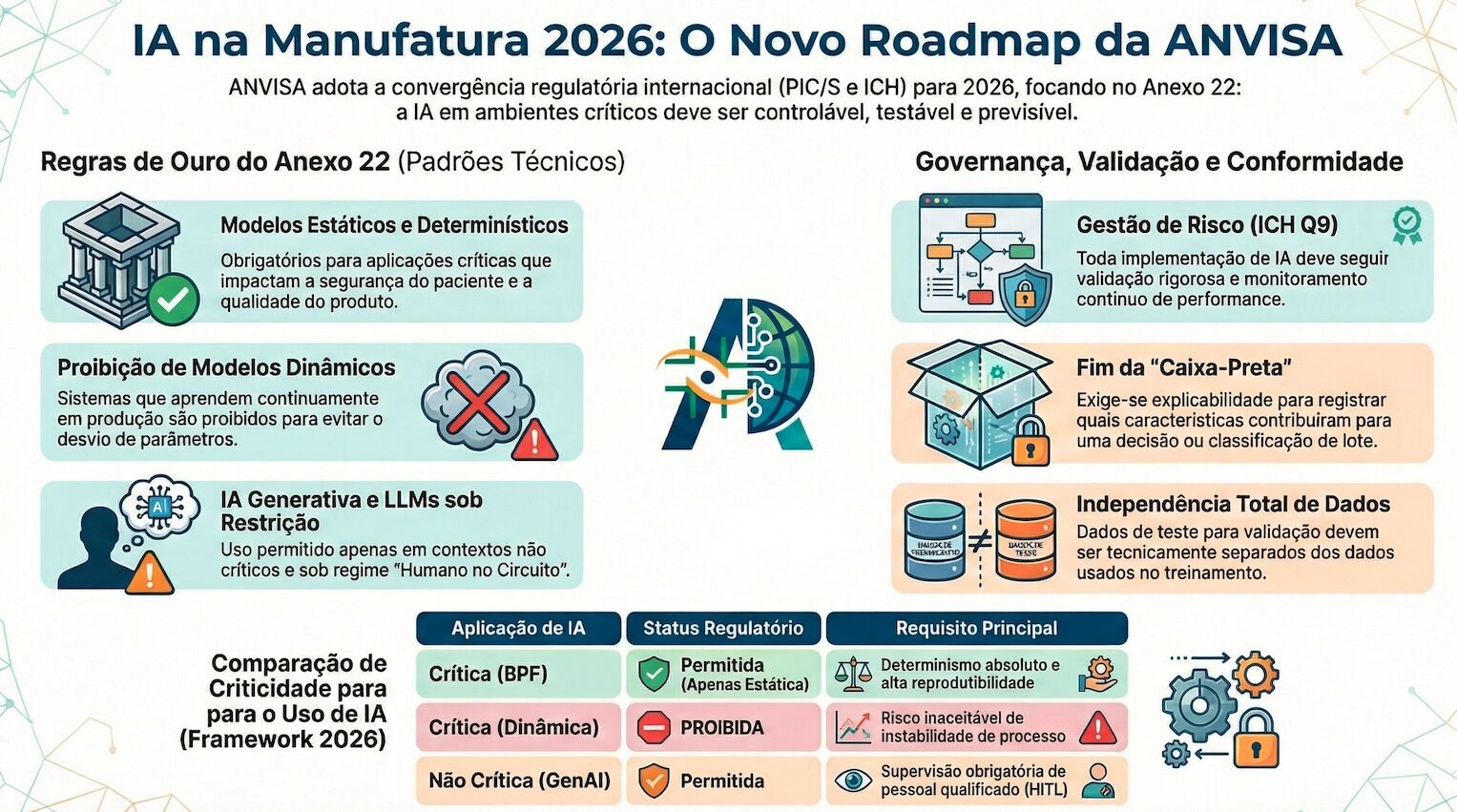
Mandatory for critical applications that impact patient safety and product quality.
Systems that continuously learn in production are prohibited to avoid parameter drift.
Use permitted only in non-critical contexts and under Human in the Loop (HITL) regime.
Every AI implementation must follow rigorous validation and continuous performance monitoring.
Explainability is required to record which characteristics contributed to a decision or batch classification.
Test data for validation must be technically separate from the data used in training.
| AI application | Regulatory status | Main requirement |
|---|---|---|
| Criticism (BPF) | Allowed (static only) | Absolute determinism and high reproducibility |
| Criticism (dynamic) | Prohibited | Unacceptable risk of process instability |
| Non-critical (GenAI) | Allowed | Mandatory supervision by qualified personnel (HITL) |
AI does not dilute regulatory responsibility, it expands it. It acts as a layer of digital evidence, providing QA, QC, Validation and Regulatory Affairs teams with the necessary analytical support for defensible decisions before health authorities.
ALCOA+ applied on an automated scale over LIMS, MES and SCADA.
Immutable, contextualized audit trails in real time.
Continuous preparation for ANVISA, FDA and EMA inspections.
Policies, roles and formal controls over the model lifecycle.
Adherence to RDC 658/2022 and harmonized international guides.
Data-driven decisions across the entire regulated operation.
Unstructured implementations generate compliance liabilities. We first work on the base/data, governance, processes and culture, so that AI operates predictably within the GMP perimeter.
Without reliable data, predictive models amplify noise rather than generating regulatory value.
Model lifecycle requires formalized policies, roles, and change control.
Unstable processes make it difficult to distinguish natural variation from real deviation.
Adoption requires data literacy across the entire quality chain — not just IT.

The next regulatory cycle will reward connected, predictable and auditable operations in real time. Digital maturity becomes a direct indicator of competitiveness.
Combined action of experts in GMP/GMP, ANVISA compliance and data scientists applied to GxP systems. Regulatory depth, not experimentation.

Specialized consultancy for the future of the pharmaceutical industry. Our mission is to do the best in GMP concepts — structuring AI projects that are born already compliant with Annex 22, ALCOA+ and the PIC/S and ICH regulatory convergence.
Schedule a technical meeting with our GMP and Artificial Intelligence experts. Receive consultative analysis on regulatory risks, AI opportunities and digital quality transformation roadmap.
The models act as a supervisory layer over LIMS, MES and SCADA systems, monitoring audit trails in real time and detecting retroactive edits, unauthorized deletions or metadata inconsistencies, preserving the Attributable, Legible, Contemporaneous, Original and Accurate principles without manual intervention.
Yes, as long as the system follows the principles of Computerized Systems Validation (CSV/CSA) and the GAMP 5 2nd Edition framework, with formal change control, risk-based qualification and continuous monitoring of model performance (model drift).
Clustering algorithms identify systemic patterns between apparently isolated occurrences, suggesting root causes and prioritizing corrective actions with a greater probability of effectiveness, reducing recurrence and the investigation cycle.
The audit is no longer based on snapshots and starts to operate continuously. The result is permanent audit-readiness, with a significant reduction in preparation time for ANVISA, FDA and EMA inspections.
No. AI acts as a precision tool. The final regulatory decision in GMP environments is always human. The role of computational intelligence is to remove the burden of manual processing and expand the specialist's analytical capacity.
Digital maturity diagnosis projects last around 4 weeks. Implementations of specific modules (e.g.: Periodic Digital Product Review, predictive environmental monitoring) take 3 to 6 months, depending on the existing data infrastructure.